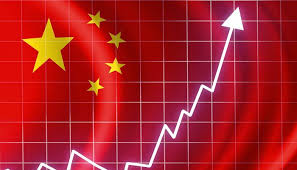
China’s economic rise over the past four decades has been one of the most astonishing events in modern history. Since Deng Xiaoping’s ‘Open Door’ policy was adopted in 1978, China has transformed from a poor agricultural country into the world’s second largest economy. Today, China is not only a manufacturing country, but also a controlling force in the global economy.
- Manufacturing Hub
China is called the “World’s Factory”. Due to cheap labor, advanced infrastructure, and large scale of production, almost all the world’s major companies manufacture their products in China. From smartphones to heavy machinery—China dominates in all fields. China is the world’s top exporter, especially in the electronics and textile sectors. - Technological Innovation and Digital Economy
China is no longer just copying other people’s technologies, but is also innovating on its own. China is making rapid progress in 5G technology, artificial intelligence (AI), and the semiconductor industry. Companies like Huawei, Alibaba, and Tencent are now directly challenging the tech giants of Silicon Valley. In addition, China is currently unrivaled in the production of electric vehicles (EVs) and renewable energy (solar panels). - Belt and Road Initiative (BRI)
A major manifestation of China’s economic power is its Belt and Road Initiative. Through this project, China is investing trillions of dollars in infrastructure development in more than 100 countries in Asia, Africa, and Europe. As a result, China’s political and economic influence in these countries is increasing and new trade routes are being opened. - Huge domestic market and middle class
China’s huge domestic market of about 1.4 billion people is one of the driving forces of its economy. In the past few decades, China has lifted billions of people out of poverty, resulting in the creation of a strong middle class in the country. The consumption power of this large population protects China’s economy from external shocks. - Foreign exchange reserves and global investment
China holds the world’s largest foreign exchange reserves (over $3 trillion). It is also one of the largest buyers of US Treasury bonds, which means that China also has an indirect influence on the US economy. In addition, Chinese state investment is spread everywhere from African mineral resources to European ports.
Current challenges
Despite being so strong, China’s economy is now facing some challenges. These include:
Demographic crisis: The number of working people is decreasing due to the declining birth rate.
Real estate crisis: The collapse of large real estate companies like Evergrande is posing a risk to the economy.
Trade wars with Western countries: Especially the chip war and tariff complications with the US.
China’s economic strength does not depend only on their GDP numbers, but also on their supply chain and investment network around the world. According to many experts, China will surpass the United States in nominal GDP to become the world’s number one economy by the 2030s. China’s economic dominance will determine the polarization of global politics in the coming days.